
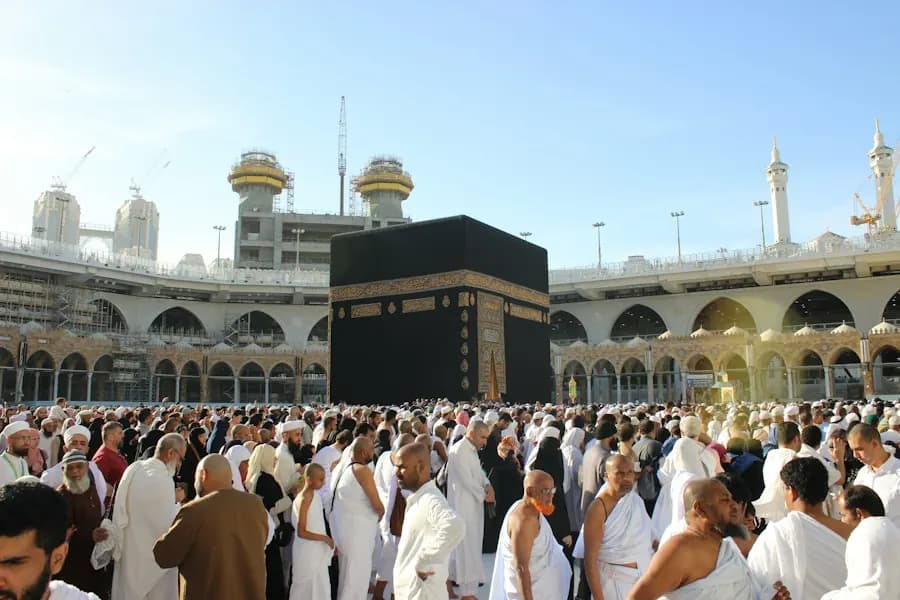
Hajj guide for Pakistan
Packages, the fard, wajib and sunnah acts, and the complete journey from Ihram to the farewell Tawaf.
Government of Pakistan Hajj Policy & Packages 2026 (حج پالیسی)
View Umrah Guidelines & NusukGovernment Regular Hajj Package (North / South)
Rs. 1,075,000 – Rs. 1,150,000 (Long Package 38-42 Days) • Rs. 1,175,000 (Short 20-25 Days)
Sponsorship Scheme (Foreign Remittance in USD): USD $3,800 to $4,200 (Exempt from general balloting draw)
Official · Ministry of Religious Affairs & Interfaith Harmony Official · Source: Ministry of Religious Affairs (mora.gov.pk) · 2026 / 1447 AH Official Policy
All pilgrims must hold a machine-readable passport valid until at least December 2026.
Government Regular Scheme (PKR)
Funded in Pakistani Rupees deposited through 15 designated commercial bank branches. Selection made via transparent computerized balloting conducted by the Ministry.
Sponsorship Scheme (USD Remittance)
Dedicated quota for overseas Pakistanis and their sponsored relatives in Pakistan. Requires foreign currency wire transfer (TT) directly to Ministry bank accounts.
Hajj: the fifth pillar of Islam
Hajj is the pilgrimage to Makkah in the month of Dhul Hijjah. It is fard once in a lifetime on every adult Muslim who is sane, healthy and able to afford the journey, with a safe route, and for a woman a mahram to travel with.
Who must perform it
Adult, sane Muslims who have the health and the means (sufficient halal money for the trip and for the family left behind).
When
The 8th to 13th of Dhul Hijjah, the 12th month of the Hijri calendar. Ihram and Umrah can begin earlier.
Where
Makkah (Masjid al-Haram), Mina, Arafah and Muzdalifah, in the Haram area of Saudi Arabia.
How often
Once in a lifetime is fard. Further Hajj is voluntary.
Hajj days (expected dates for the next Hajj)
- Yawm at-Tarwiyah, Mina
- 8 Dhul Hijjah
- Sat, 15 May 2027
- Arafah and Muzdalifah
- 9 Dhul Hijjah
- Sun, 16 May 2027
- Eid-ul-Adha, stoning, sacrifice, Tawaf
- 10 Dhul Hijjah
- Mon, 17 May 2027
- Days of Tashriq, Mina
- 11 to 13 Dhul Hijjah
- from Tue, 18 May 2027
Dates are worked out from the Hijri calendar and can move by a day with the moon sighting in Saudi Arabia. Follow the announcement of the Hajj authorities.
Three ways to perform Hajj
The type of Hajj you perform is decided when you make your niyyah at the Miqat. The rites on the days of Hajj are the same for all three.
Tamattu'
تمتعUmrah first, leave Ihram, then a new Ihram for Hajj on 8 Dhul Hijjah. A sacrifice is wajib. This is the most common type for pilgrims arriving early on the Pakistan scheme.
Qiran
قرانUmrah and Hajj in a single Ihram without leaving it in between. A sacrifice is wajib. Hanafi scholars consider it the best form.
Ifrad
إفرادHajj alone, in Ihram from the Miqat until the 10th. No sacrifice is required (it is voluntary).
Fard, wajib and sunnah of Hajj
This follows the Hanafi school, which most Pakistanis follow, and notes where the other schools differ. Missing a fard means the Hajj is not valid. Missing a wajib requires a penalty (dam, a sacrifice). Missing a sunnah has no penalty but loses reward.
Arkan: the essentials without which Hajj is invalid
- 1
Ihram
إحرامThe sacred state entered at the Miqat with the intention (niyyah) for Hajj and the Talbiyah. It is a condition of the Hajj itself: without it no rite is valid. Men wear two unsewn white sheets; women wear their ordinary modest clothes with the face uncovered.
Other schools: Shafi'i, Maliki and Hanbali scholars count Ihram as a pillar (rukn).
- 2
Wuquf at Arafah
وقوف عرفةBeing present in the plain of Arafah on 9 Dhul Hijjah, from after midday (zawal) until Fajr of the 10th. Hajj is not valid without it: "Hajj is Arafah" (Tirmidhi). Staying until sunset is wajib. Uranah valley is outside Arafah.
- 3
Tawaf al-Ziyarah (Tawaf al-Ifadah)
طواف الزيارةThe obligatory Tawaf of the Kaaba after Muzdalifah and Mina. At least four of the seven circuits are fard and the remaining three are wajib. Its proper time is 10 to 12 Dhul Hijjah; it may be delayed but a penalty (dam) applies if it is done after the 12th.
Obligatory acts: leaving one needs a dam
- 1
Entering Ihram from the Miqat
Do not cross your Miqat without Ihram. Pilgrims flying from Pakistan usually put on Ihram before the aircraft crosses Yalamlam; those going to Madinah first use Dhul Hulaifah (Abyar Ali). Your group leader announces the exact point.
- 2
Sa'i between Safa and Marwa
سعيSeven laps, starting at Safa and ending at Marwa, after a Tawaf. Wajib in the Hanafi school.
Other schools: Shafi'i, Maliki and Hanbali scholars count Sa'i as a pillar of Hajj.
- 3
Staying at Arafah until sunset
Leave Arafah only after the sun has set. Leaving earlier requires a dam unless you return before sunset.
- 4
Wuquf at Muzdalifah
مزدلفةA stay at Muzdalifah after Fajr on 10 Dhul Hijjah, from dawn until shortly before sunrise. The night spent there is sunnah. The sick, elderly and women who fear the crowd may leave after midnight.
- 5
Rami: stoning the Jamarat
رمي الجمارSeven pebbles at Jamrat al-Aqabah on the 10th; seven at each of the three Jamarat on the 11th and 12th (and the 13th if you stay). Throw one pebble at a time, and in the order Aqabah on the 10th; Sughra, Wusta, Kubra afterwards.
- 6
Halq or Taqsir
حلق / تقصيرMen shave the head (better) or trim the hair. Women trim a fingertip length from the ends of their hair. It must be done within the Haram and on or after the 10th, after the stoning and sacrifice.
- 7
Sacrifice (Hady / Dam-e-Shukr)
Wajib for those performing Tamattu' or Qiran: a sheep or goat, or a share in a camel or cow, slaughtered in the Haram on 10 to 12 Dhul Hijjah. Pilgrims on the Pakistan government scheme normally arrange this through the official voucher.
- 8
Keeping the order on the 10th
Stoning Jamrat al-Aqabah, then sacrifice, then shaving or trimming. Doing them out of order can require a dam in the Hanafi school.
- 9
Tawaf al-Wida (farewell Tawaf)
طواف الوداعThe last Tawaf before leaving Makkah, wajib for pilgrims from outside the Miqat boundary. A woman in her period is excused.
Recommended acts of the Prophet ﷺ
- 1
Ghusl and two raka'at before Ihram
Bathe, wear the Ihram, pray two raka'at nafl and then make the niyyah and recite the Talbiyah.
- 2
Tawaf al-Qudum
The arrival Tawaf for those performing Ifrad or Qiran, with Raml (brisk walk) in the first three circuits and Idtiba (right shoulder uncovered) for men.
- 3
Mina on the 8th and the night of the 9th
Reach Mina on 8 Dhul Hijjah, pray the five prayers there, and leave for Arafah after sunrise on the 9th.
- 4
Nights in Mina (10th, 11th and 12th)
Spending the nights of the stoning days in Mina is sunnah in the Hanafi school.
Other schools: The majority of scholars count it as wajib.
- 5
Reciting the Talbiyah often
Until the first pebble is thrown at Jamrat al-Aqabah on the 10th.
This is a learning summary, not a fatwa. For specific situations (illness, a missed rite, a penalty), ask your group's scholar or a qualified mufti.
The complete Hajj journey, step by step
From your intention at home to the farewell Tawaf. The order below is for a Tamattu' pilgrim; Qiran and Ifrad pilgrims follow the same days from the 8th.
Before you travel
At home
Prepare your intention and your paperwork
- Hajj is fard once in a lifetime for every adult Muslim who is sane and able, in health and means, with a safe route (and a mahram for women).
- Settle debts, make a will (wasiyyah), seek forgiveness from people you have wronged, and use only halal money.
- Keep a machine-readable passport valid for the required period, the Hajj vaccination card (meningitis and any others the Ministry requires) and your allotted documents.
- Learn the rites with your group's scholar and practise Tawaf and Sa'i supplications before you leave.
On the way to Makkah
The Miqat
Enter Ihram
- Trim nails and hair, perform ghusl (or wudu), and put on the Ihram. Men: two unsewn white sheets. Women: ordinary modest clothes, no face veil and no gloves.
- Pray two raka'at, make the niyyah for Umrah (Tamattu'), Hajj (Ifrad) or both (Qiran), and recite the Talbiyah: Labbayk Allahumma labbayk, labbayka la sharika laka labbayk, innal-hamda wan-ni'mata laka wal-mulk, la sharika lak.
- From now on the prohibitions of Ihram apply: no perfume, cutting hair or nails, hunting, marital relations, covering the head (men), wearing sewn clothes (men), arguing or sinful speech.
On arrival
Masjid al-Haram
Tawaf and Sa'i (Umrah for Tamattu' pilgrims)
- Tawaf: seven circuits of the Kaaba anticlockwise, starting and ending at the Black Stone, with Raml and Idtiba for men in the first three circuits.
- Pray two raka'at behind Maqam Ibrahim and drink Zamzam.
- Sa'i: seven laps between Safa and Marwa, starting at Safa and finishing at Marwa.
- Shave or trim your hair. Tamattu' pilgrims are now out of Ihram until the 8th; Qiran and Ifrad pilgrims stay in Ihram.
8 Dhul Hijjah
Makkah to Mina
Sat, 15 May 2027
Yawm at-Tarwiyah
- Tamattu' pilgrims enter Ihram for Hajj from their lodging, make the niyyah and recite the Talbiyah.
- Travel to Mina, pray Dhuhr, Asr, Maghrib, Isha and then Fajr of the 9th there, each at its own time.
- Spend the day and night in worship, dhikr and the Talbiyah.
9 Dhul Hijjah
Arafah
Sun, 16 May 2027
Yawm Arafah: the heart of Hajj
- After sunrise, go to Arafah and remain within its boundaries. Uranah valley is not part of Arafah.
- Dhuhr and Asr are combined behind the imam only if you are in Ihram and pray with the Hajj imam (Hanafi); otherwise pray each in its own time.
- Stay from midday until sunset making dua, istighfar and dhikr. The best dua is: La ilaha illallah wahdahu la sharika lah, lahul-mulku wa lahul-hamd, wa huwa 'ala kulli shay'in qadir.
- Do not leave before sunset. Leave after sunset without praying Maghrib at Arafah.
Missing Arafah means missing Hajj.
Night of 9 to 10 Dhul Hijjah
Muzdalifah
Maghrib and Isha together, pebbles and rest
- On arrival at Muzdalifah, pray Maghrib and Isha together at the time of Isha: three raka'at of Maghrib, then two of Isha.
- Collect pebbles the size of a chickpea: 7 for the 10th, and 21 each for the 11th and 12th, 49 in all (70 if you will stay for the 13th).
- Sleep and rest, then pray Fajr and stay in dhikr and dua (wuquf) until shortly before sunrise, then leave for Mina.
- The sick, elderly and women with them may move on after midnight.
10 Dhul Hijjah
Mina and Makkah
Mon, 17 May 2027
Yawm an-Nahr (Eid day)
- Stop the Talbiyah when you throw the first pebble at Jamrat al-Aqabah (the large Jamarah). Throw seven pebbles one at a time, saying Allahu Akbar with each.
- Offer the sacrifice (for Tamattu' and Qiran) or confirm it has been done on your behalf.
- Shave or trim your hair. You are now released from most Ihram restrictions (first tahallul), except marital relations.
- Go to Makkah for Tawaf al-Ziyarah and Sa'i (for Tamattu' pilgrims, and for Qiran and Ifrad pilgrims who have not yet done Sa'i). All restrictions are now lifted (second tahallul).
Tawaf al-Ziyarah may be delayed until the 12th, but not beyond without a penalty.
11 and 12 Dhul Hijjah
Mina
from Tue, 18 May 2027
Days of Tashriq: stoning of the three Jamarat
- After midday each day, throw seven pebbles at each of the three Jamarat in order: Jamrat as-Sughra (small), al-Wusta (middle), then al-Kubra (Aqabah).
- Make a long dua facing the Qiblah after the first and second, but not after the last.
- Stay the nights of the 11th and 12th in Mina.
- You may leave Mina on the 12th before sunset. If the sun sets or Fajr of the 13th arrives while you are still in Mina, stay and stone again on the 13th.
Before leaving Makkah
Masjid al-Haram
Tawaf al-Wida (farewell Tawaf)
- Make the final Tawaf of seven circuits as the last act before leaving Makkah. No Sa'i follows it.
- A woman in her period is excused from this Tawaf.
Before or after Hajj
Madinah
Visit to Masjid an-Nabawi (not a part of Hajj)
- Pray in Masjid an-Nabawi, send salutations on the Prophet ﷺ at his Rawdah and greet Abu Bakr and Umar (may Allah be pleased with them).
- Visit Jannat al-Baqi, Quba Mosque and Uhud as time allows. The visit is highly recommended but is not a condition of Hajj.
What is forbidden in Ihram
- Wearing sewn clothing, socks that cover the ankle bone, or covering the head (men)
- Covering the face with a niqab or wearing gloves (women)
- Using perfume or scented soap, on body or clothes
- Cutting or removing hair or nails
- Hunting or harming land animals, or cutting living plants in the Haram
- Marriage proposals, contracts, or marital relations
- Quarrelling, swearing or sinful speech
The Talbiyah
لَبَّيْكَ اللَّهُمَّ لَبَّيْكَ، لَبَّيْكَ لَا شَرِيكَ لَكَ لَبَّيْكَ، إِنَّ الْحَمْدَ وَالنِّعْمَةَ لَكَ وَالْمُلْكَ، لَا شَرِيكَ لَكَ
Here I am, O Allah, here I am. Here I am, You have no partner, here I am. Truly all praise, grace and sovereignty are Yours. You have no partner.
Men recite it aloud, women softly, from Ihram until the first pebble on the 10th.
Breaking one of these in Ihram can require a fidya or dam depending on the act; ask your group scholar.
Guidance for women
- A woman needs a mahram (husband or close male relative) for the journey, according to the Hanafi school.
- If she is in her period, she can perform every rite of Hajj except Tawaf and the prayer; she waits to be clean before Tawaf al-Ziyarah. Tawaf al-Wida is waived.
- She enters Ihram in her usual modest clothes and may use a cap or cloth to keep a veil away from her face.
- For Halq, she trims about a fingertip length from the ends of her hair.
Common questions about Hajj
What are the arkan (pillars) of Hajj?
In the Hanafi school the fard parts of Hajj are Ihram, Wuquf at Arafah on 9 Dhul Hijjah and Tawaf al-Ziyarah. Other schools list four pillars: Ihram, Wuquf at Arafah, Tawaf al-Ifadah and Sa'i.
What are the wajibat of Hajj?
Entering Ihram from the Miqat, Sa'i between Safa and Marwa, staying at Arafah until sunset, Wuquf at Muzdalifah, stoning the Jamarat, Halq or Taqsir, the sacrifice for Tamattu' and Qiran, keeping the order on the 10th, and Tawaf al-Wida.
What is the order of the Hajj days?
8 Dhul Hijjah: Mina. 9th: Arafah, then Muzdalifah at night. 10th: stoning Jamrat al-Aqabah, sacrifice, shaving or trimming, Tawaf al-Ziyarah. 11th and 12th (and 13th): stoning the three Jamarat in Mina. Before leaving Makkah: Tawaf al-Wida.
Which type of Hajj is best?
Hanafi scholars prefer Qiran, then Tamattu', then Ifrad. Many pilgrims on the Pakistan government scheme perform Tamattu' because they arrive earlier than the Hajj days.
Also see our Umrah guide, Zakat calculator and Islamic calendar.